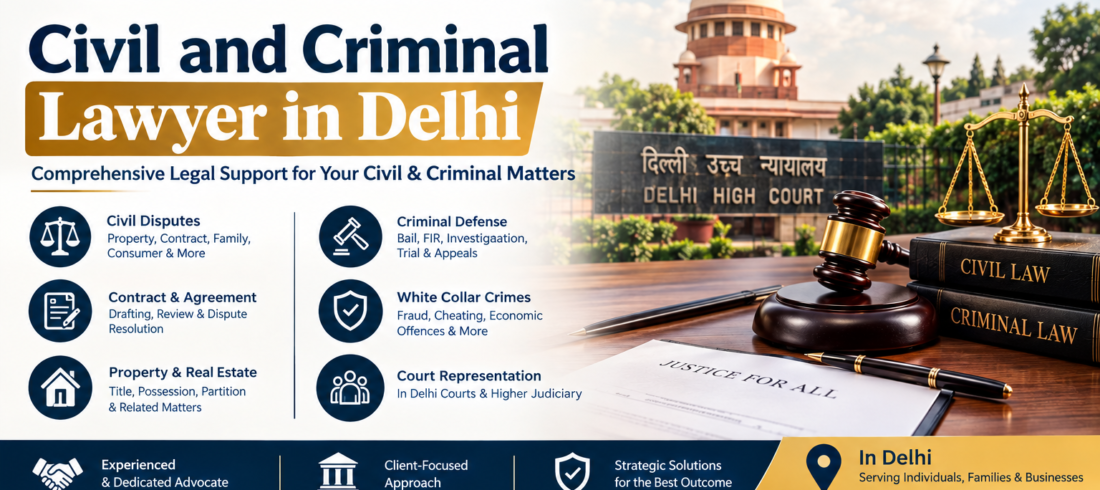
Legal disputes can arise from property disagreements, contractual issues, family conflicts, financial transactions, criminal allegations, FIRs, bail proceedings and many other situations. A Civil and Criminal Lawyer in Delhi can help individuals and businesses understand their legal position, available remedies and the appropriate procedure for protecting their interests.
Civil and criminal matters are different in nature and follow different legal procedures. Civil litigation generally concerns disputes involving rights, obligations, property, contracts, money or other civil remedies, while criminal proceedings concern alleged offences and may involve investigation, arrest, bail, trial and appeals.
For individuals seeking legal assistance in Delhi, Jaitegan Singh Khurana operates a litigation and dispute-resolution practice with a stated focus on civil and criminal litigation. The firm’s website lists criminal investigations, bail matters, trials and appeals among its criminal litigation services and states that it appears before the Supreme Court of India, High Courts, District Courts and tribunals.
Key Takeaways
- Civil and criminal cases involve different legal procedures and remedies.
- Civil disputes may involve property, contracts, money recovery, business disputes and other legal rights.
- Criminal matters may involve FIRs, investigation, arrest, bail, trial and appeals.
- Early legal assessment can help identify the appropriate forum, remedy and documentation.
- Evidence and proper documentation are important in both civil and criminal proceedings.
- The outcome of any case depends on its facts, applicable law and evidence; no lawyer can guarantee a particular result.
What Does a Civil and Criminal Lawyer in Delhi Do?
A lawyer handling civil and criminal litigation may advise and represent clients in different stages of legal proceedings.
Depending on the matter, services can include:
- Case assessment
- Legal consultation
- Drafting legal notices
- Civil litigation
- Criminal defence
- FIR-related legal assistance
- Bail proceedings
- Trial representation
- Evidence-related assistance
- Interim applications
- Appeals
- Revisions
- Settlement and negotiation
- Arbitration or mediation where appropriate
- Representation before courts and tribunals
The exact scope of legal assistance depends on the nature of the dispute and the applicable law.
Civil Law Matters in Delhi
Civil litigation generally concerns disputes involving private rights, obligations, property, contracts, money or other civil remedies.
Common civil matters can include:
- Property disputes
- Ownership disputes
- Partition disputes
- Possession matters
- Contractual disputes
- Money recovery
- Injunction proceedings
- Commercial disputes
- Partnership disputes
- Real estate disputes
- Specific performance matters
- Civil appeals
- Declaratory proceedings
The appropriate legal remedy depends on the facts and the rights involved.
Property and Real Estate Disputes
Property disputes can involve substantial financial and legal interests.
Common issues include:
- Ownership
- Title disputes
- Possession
- Sale agreements
- Partition
- Inheritance-related property disputes
- Property documentation
- Encroachment
- Lease disputes
- Construction-related disagreements
Before initiating property litigation, it is important to review title documents, agreements, registration records, correspondence and other relevant evidence.
The Jaitegan Singh Khurana website separately identifies Property & Real Estate Law as a practice area covering property transactions, title verification, ownership disputes, partition suits and real estate documentation.
Contract and Commercial Disputes
Businesses and individuals frequently encounter disputes involving agreements.
These may concern:
- Non-payment
- Breach of contract
- Delayed performance
- Contract termination
- Service agreements
- Vendor disputes
- Partnership agreements
- Business transactions
- Commercial obligations
A lawyer can review the contract and related correspondence to determine what contractual and legal remedies may be available.
Money Recovery Matters
Money recovery disputes may arise from unpaid invoices, loans, commercial transactions or contractual obligations.
Relevant documents may include:
- Agreements
- Invoices
- Bank statements
- Payment records
- Emails
- Messages
- Acknowledgements of liability
- Legal notices
Depending on the circumstances, a legal notice, negotiation, civil recovery proceedings, arbitration or another appropriate remedy may be considered.
Criminal Law Matters in Delhi
Criminal proceedings involve allegations that an offence has been committed.
A criminal lawyer may assist with matters involving:
- FIRs
- Police complaints
- Arrest
- Bail
- Anticipatory bail
- Regular bail
- Criminal investigation
- Criminal trials
- Evidence
- Criminal appeals
- Revisions
- Quashing-related proceedings where legally maintainable
The applicable provisions depend on the date and nature of the alleged offence and the legislation governing the matter.
FIR and Criminal Complaint Assistance
An FIR or criminal complaint can have significant legal consequences.
A lawyer may help a client understand:
- The allegations
- The applicable offences
- Available procedural remedies
- Investigation-related issues
- Evidence requirements
- Bail options
- Potential court proceedings
Individuals should avoid making inaccurate statements or destroying relevant evidence after becoming involved in a criminal dispute.
Bail and Anticipatory Bail
Bail is an important aspect of criminal litigation.
Depending on the circumstances, a person may need legal assistance concerning:
- Regular bail
- Anticipatory bail
- Bail during investigation
- Bail during trial
- Bail conditions
- Bail cancellation
- Appeals concerning bail orders
Anticipatory bail and regular bail involve different procedural circumstances, and availability depends on the applicable law and facts of the case.
A lawyer can review the allegations, FIR or complaint, investigation status and other relevant circumstances before advising on the appropriate legal remedy.
Criminal Trial and Defence
Criminal defence may involve several stages.
These can include:
Investigation
The investigation may involve statements, documents, electronic evidence, forensic material and other evidence.
Charges
Where applicable, the court considers the material placed before it in accordance with the applicable criminal procedure.
Evidence
The prosecution and defence may rely on relevant documentary, oral, electronic or other legally admissible evidence.
Cross-Examination
Where witnesses are examined, cross-examination can be an important part of the trial process.
Final Arguments
The parties present their respective legal and factual submissions based on the evidence and applicable law.
Judgment and Further Remedies
Depending on the outcome and legal circumstances, appellate or revisionary remedies may be available.
Civil and Criminal Proceedings Can Sometimes Arise From the Same Dispute
A single underlying dispute can sometimes result in both civil and criminal proceedings.
For example, a business disagreement may involve:
- A contractual dispute
- A payment claim
- Allegations of cheating or breach of trust
- Criminal complaints
- Arbitration proceedings
The fact that civil and criminal proceedings arise from related circumstances does not automatically mean that one proceeding determines the other. Each matter must be assessed according to the applicable law and facts.
This is one reason why early legal analysis can be useful.
Cyber Crime and Digital Evidence
Modern civil and criminal disputes increasingly involve electronic records.
Potential evidence may include:
- Emails
- WhatsApp messages
- Social-media communications
- Bank transaction records
- CCTV footage
- Electronic contracts
- Call records where legally obtained
- Digital files
- Website records
The Jaitegan Singh Khurana website also lists Cyber Law & Digital Crimes as a practice area, including cyber fraud, online harassment, data privacy and hacking-related matters.
Digital evidence should be preserved carefully and should not be manipulated or deleted.
Civil and Criminal Litigation at Different Courts
The appropriate court or forum depends on the nature of the matter, territorial jurisdiction, pecuniary jurisdiction, subject-matter jurisdiction and applicable legislation.
Depending on the case, proceedings may involve:
- District Courts
- Sessions Courts
- High Courts
- Supreme Court of India
- Commercial Courts
- Tribunals
- Arbitration forums
- Other specialised legal forums
Jaitegan Singh Khurana’s website states that the practice appears before the Supreme Court of India, High Courts, District Courts and tribunals across the country.
Importance of Evidence in Civil and Criminal Cases
Evidence is central to litigation.
In Civil Cases
Relevant material may include:
- Agreements
- Property documents
- Receipts
- Invoices
- Bank records
- Correspondence
- Photographs
- Government records
- Expert reports
In Criminal Cases
Relevant material may include:
- FIR and complaint records
- Statements
- Documentary evidence
- Electronic evidence
- Forensic material
- CCTV footage
- Transaction records
- Witness testimony
The relevance and admissibility of evidence depend on the applicable law and facts.
Legal Notices and Pre-Litigation Strategy
A legal notice can sometimes be useful before initiating litigation.
It may communicate:
- The legal claim
- The factual basis
- The alleged breach or wrongdoing
- The remedy sought
- A proposed deadline for compliance
However, sending a notice is not always mandatory, and the appropriate approach depends on the nature of the dispute and applicable law.
Settlement, Mediation and Arbitration
Not every dispute needs to proceed through a full trial.
Depending on the matter, parties may consider:
- Negotiation
- Mediation
- Conciliation
- Arbitration
- Settlement
These options can sometimes provide a more efficient way of resolving suitable disputes.
The Jaitegan Singh Khurana website lists Arbitration & Conciliation as a separate practice area for commercial and civil disputes.
Whether an alternative dispute-resolution mechanism is available depends on the agreement between the parties, applicable law and nature of the dispute.
Documents to Keep Ready for a Lawyer
Before consulting a lawyer, organise relevant documents.
For Civil Matters
You may need:
- Agreements
- Sale deeds
- Property documents
- Invoices
- Bank records
- Notices
- Court orders
- Correspondence
- Photographs
- Previous pleadings
For Criminal Matters
You may need:
- FIR copy
- Complaint
- Police notices
- Arrest-related documents
- Bail orders
- Charge-sheet documents, if available
- Court orders
- Relevant communications
- Digital evidence
- Other documents connected with the allegations
A complete document set can help the lawyer understand the matter more efficiently.
How to Choose a Civil and Criminal Lawyer in Delhi
When selecting legal counsel, consider:
Relevant Litigation Experience
Look for experience relating to the specific type of civil or criminal dispute you are facing.
Understanding of Procedure
Litigation involves procedural requirements, filing rules, evidence and court deadlines.
Communication
Your lawyer should explain the legal position and procedural steps clearly.
Documentation
A careful review of documents is essential in most litigation matters.
Strategic Assessment
Different cases may require different approaches. A lawyer should assess the facts before recommending a legal course of action.
Civil and Criminal Litigation at Jaitegan Singh Khurana
Jaitegan Singh Khurana is a litigation and dispute-resolution practice based in Delhi. Its current website identifies Civil and Criminal Litigation as one of its core practice areas.
According to the firm’s website, its criminal litigation work includes defending clients in criminal investigations, bail matters, trials and appeals. The website also states that the practice appears before the Supreme Court of India, High Courts, District Courts and tribunals.
The practice also lists areas including matrimonial and family disputes, property and real estate law, corporate and commercial law, arbitration and conciliation, cyber law and digital crimes, insolvency and bankruptcy, and corporate advisory work.
The firm’s Delhi office is listed at:
C-6, LGF, Hauz Khas, New Delhi – 110016, India
The website lists +91 9991168994 as its contact number and jaitegan@momentum-law.com as its office email.
You can visit https://jaitegansinghkhurana.com/ for further information about the practice and its areas of legal work.
When Should You Consult a Lawyer?
It can be useful to obtain legal advice at an early stage if you:
- Receive a legal notice
- Face a property dispute
- Have a contractual disagreement
- Need to recover money
- Receive an FIR or police notice
- Are concerned about arrest
- Need bail advice
- Are involved in a criminal investigation
- Receive a court summons
- Need to file a civil or criminal proceeding
- Want to challenge an order
- Need advice concerning an appeal
- Are considering settlement or mediation
Early legal advice can help you understand the available options before taking steps that may have legal consequences.
Frequently Asked Questions
1. What does a Civil and Criminal Lawyer in Delhi handle?
A Civil and Criminal Lawyer in Delhi may handle civil disputes involving property, contracts, money recovery and other legal rights, as well as criminal matters involving FIRs, investigation, bail, trials and appeals.
2. Can one lawyer handle both civil and criminal matters?
A litigation practice may handle both civil and criminal matters, depending on the lawyer’s experience and the nature of the case.
3. Can a property dispute also involve criminal proceedings?
In some circumstances, allegations arising from a property dispute may lead to criminal proceedings. Whether criminal liability exists depends on the specific facts and applicable law.
4. Can I get bail through a criminal lawyer?
A lawyer can represent a person in a bail proceeding and present legally relevant grounds. However, the decision to grant or refuse bail is made by the competent court based on the applicable law and circumstances.
5. Can a civil dispute be settled through mediation?
Yes. Depending on the nature of the dispute, parties may explore mediation or another alternative dispute-resolution mechanism.
6. What should I bring to my first consultation?
Bring relevant agreements, notices, court documents, FIRs, orders, correspondence, financial records and other documents connected with the dispute.
7. Does Jaitegan Singh Khurana handle civil and criminal litigation in Delhi?
Yes. The firm’s current website lists Civil and Criminal Litigation as a practice area and states that it handles criminal investigations, bail, trials and appeals.
Conclusion
Civil and criminal disputes can involve significant legal, financial and personal consequences. Understanding the applicable law, jurisdiction, evidence and procedural requirements is therefore important before taking legal action.
A Civil and Criminal Lawyer in Delhi can assist with legal assessment, documentation, notices, litigation, bail proceedings, trials, appeals, negotiations and other appropriate legal remedies depending on the circumstances.
For legal information and assistance, visit https://jaitegansinghkhurana.com/ to explore the civil and criminal litigation practice of Jaitegan Singh Khurana.